StackGP.stackGPModelComplexity#
StackGP.stackGPModelComplexity(model)
stackGPModelComplexity is a StackGP function that computes the combined stack length for a GP model. This is the default complexity measure used in search.
The function expects 1 argument: model
The argument is described below:
model: A StackGP model.
First we need to load in the necessary packages
import StackGP as sgp
import numpy as np
Overview#
Computing complexity for a random model#
Here we generate a random model with up to 4 variables, the default operator set, the default constant set, and a maxSize of 10.
randomModel=sgp.generateRandomModel(4, sgp.defaultOps(), sgp.defaultConst(), 10)
We can display the random model below
sgp.printGPModel(randomModel)
Now we can compute the model complexity
sgp.stackGPModelComplexity(randomModel)
7
Examples#
This section provides some interesting examples to demonstrate how stackGPModelComplexity can be used.
Checking complexity of best evolved model#
Likely, we are interested in determining the complexity of models evolved.
Lets start by generating a training and test set with 4 features.
trainInputData = np.random.rand(4, 100)
randomModel = sgp.generateRandomModel(4, sgp.defaultOps(), sgp.defaultConst(), 10)
display(sgp.printGPModel(randomModel))
trainResponse = sgp.evaluateGPModel(randomModel, trainInputData)
Now lets evolve a model population using the training data.
models=sgp.evolve(trainInputData, trainResponse, tracking=True)
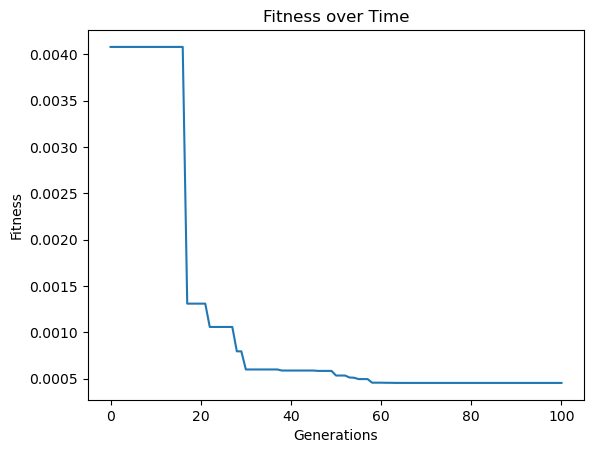
Now lets pick the best model evolved from the population.
bestModel = models[0]
sgp.printGPModel(bestModel)
Now lets evaluate the complexity of the best model.
sgp.stackGPModelComplexity(models[0])
11
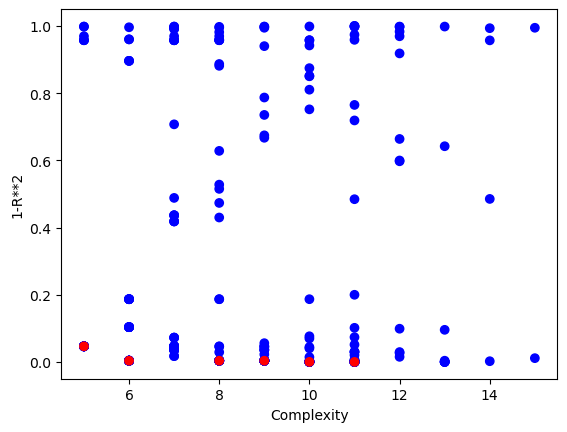
We can also visualize the Pareto front plot of the model population to see the complexity-accuracy trade-off of all models in the population.
sgp.plotModels(models)
Using stackGPModelComplexity as a Fitness Objective#
The default fitness objectives used during search are fitness and stackGPModelComplexity. Here we show how to manually specify using stackGPModelComplexity, although, in practice it isn’t necessary.
We will use a randomly generated model to generate the response. So we start with generating a random model.
randomModel=sgp.generateRandomModel(4, sgp.defaultOps(), sgp.defaultConst(), 20)
sgp.printGPModel(randomModel)
Now we can generate some data and use the above random model to generate the response from the random input data.
inputData = np.random.rand(4, 100)
response = sgp.evaluateGPModel(randomModel, inputData)
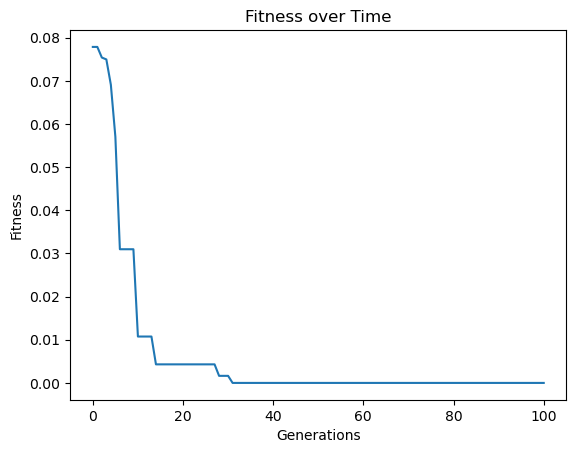
Now we can evolve models to fit the generated training data. We will manually set fitness and stackGPModelComplexity as the fitness objectives.
models = sgp.evolve(inputData,response, tracking=True, modelEvaluationMetrics=[sgp.fitness, sgp.stackGPModelComplexity])
Now we can look at the best model generated.
sgp.printGPModel(models[0])
Now we can view the complexity of that best model.
sgp.stackGPModelComplexity(models[0])
10
We can also view the Pareto front plot of the evolved model population to see the complexity-accuracy trade-off of all models in the population.
sgp.plotModels(models)
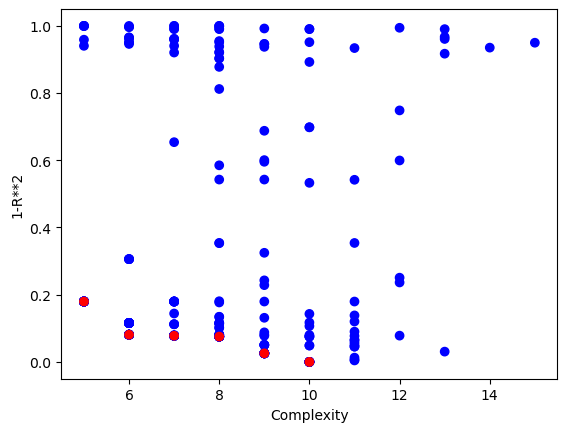
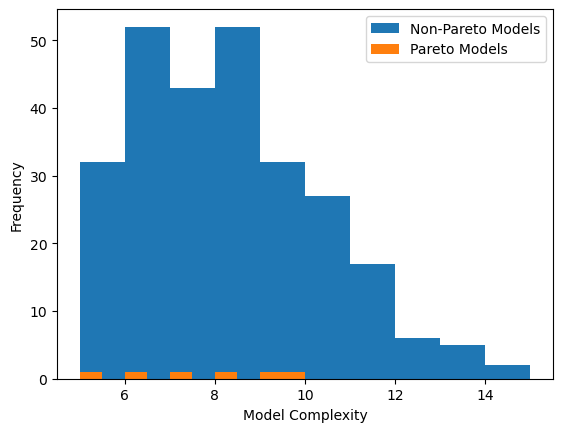
We could also plot the complexity distribution in the population.
sgp.plotModelComplexityDistribution(models)